
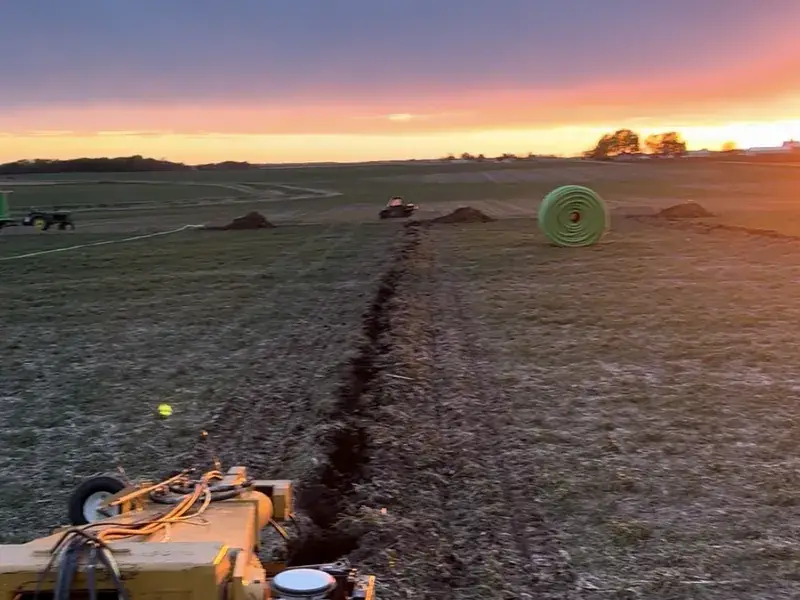
Begin With the Affected Ground
Agricultural drainage planning starts with the field area showing a problem, the pattern of wetness and what is known about existing tile. A single wet spot may connect to a larger system, and an old line may not follow an obvious route. Share maps, outlet information, repair history and any observations about when the issue appears. Salz provides field tile work as a defined service, but does not pretend that every buried line can be located or diagnosed from surface symptoms alone.
Share what the field is doing now, where water tends to remain, and whether you are discussing new tile or repair of an existing system.
For non-farm drainage concerns, see drainage improvements; if the field system also requires trench work, review the project with our excavation team.
Available Agricultural Drainage Work
Agricultural drainage services include field tile installation and farm tile repair and maintenance. The exact combination depends on the property and requested result. Each item is discussed as a scope, not a promise that every method fits every site.
- Field tile installation
- Farm tile repair and maintenance
Field Tile Installation
New field tile creates a planned subsurface route for excess water. Layout, depth, fall, outlet and connection details are essential to a useful installation. The requested scope should be based on the landowner’s drainage goal and available planning information. Salz handles excavation and installation-related earthwork within the agreed project. Engineering, conservation requirements, permits or other responsibilities should be identified separately when they apply rather than assumed to be included.
Farm Tile Repair
Existing tile can be damaged, blocked, separated or otherwise fail to carry water as intended. Repair begins with narrowing the likely problem area and exposing enough of the system to understand the condition. Useful clues include visible blowouts, persistent wet patterns, recent digging and locations where tile is known to cross. Because buried conditions can differ from expectations, Salz gives direct information about what is found instead of promising a simple repair before the line is opened.
Maintenance and System Context
Maintenance may involve investigating a recurring trouble area, opening an outlet or repairing an accessible section, depending on the existing system and agreed work. A repair should also consider how the section fits into the larger route. Replacing one piece cannot solve a limitation elsewhere in the system. Landowners should share known downstream and upstream connections so the work is not treated in isolation.
Trenching, Backfill and Field Access
Tile work requires trenching and backfill across working ground. Crop status, field access, surface conditions and routes for equipment are practical scheduling and scope questions. Salz keeps trenching claims within the company’s legal role and does not make unsupported statements about licenses, locates or regulatory tasks. Clarify known private lines and coordination responsibilities before excavation. The expected surface finish should also be part of the estimate.
Agricultural Work Within the Service Area
Salz is based in Magnolia, Illinois and serves surrounding rural properties, generally within about 50 miles. Projects up to roughly 1.5 hours away may be considered. The company’s broader services include pond construction, land clearing, excavation and site preparation, which may be relevant to a farm property but remain separate scopes. Call during Monday-through-Saturday hours or send project details to request a free estimate.
Map What Is Known Before Digging
Even a hand-marked map can help organize known outlets, mains, laterals, wet areas and past repairs. Add dates or field observations where possible. Do not convert uncertain recollections into exact line locations; mark them as approximate. That distinction helps the estimate separate planned installation from investigative excavation and limits the risk of basing the whole repair on a guessed route.
Protect the Function of Connected Tile
A field tile section usually serves or connects with other sections. Before changing it, consider upstream water and the capacity or condition of the downstream route. Salz can repair exposed defects and install agreed tile, but should not claim that one replacement fixes an entire unknown system. A clear scope states which segment is included and what larger-system questions remain outside it.
Coordinate Timing With Field Conditions
Access across agricultural ground depends on what is happening at the property and the surface condition when work is planned. Share cropping, gates, lanes and areas that should not be crossed. Wet ground can also be the symptom under investigation while making equipment access more difficult. Scheduling remains project-specific; Salz does not promise an immediate response or fixed work window beyond the published business hours.
After work, keep a record of the repaired or installed section and its relationship to known lines. That information may help with future field decisions and prevents the completed route from becoming another unknown buried feature.